April 9th is IoT Day, an occasion we first celebrated in 2013 when reelyActive was a mere 9 months old. If you had asked us then where we’d expect “things” to be in 2026, we’d likely have argued that:
- IoT would be ubiquitous, like the Internet itself
- the next industrial revolution would be well underway, fueled by the transformational gains in the efficiency enabled by the IoT
- reelyActive would have fulfilled its mission, and our time would be freed up to find novel ways to contribute towards humanity’s collective leap forward
Of course, it’s difficult to predict the future, and, alas, in hindsight, we were naively optimistic. Not about technology: we can easily argue that the above was technically possible a decade ago. Rather, our prediction failed to take into account to what ends those enabling technologies would instead be directed based on shorter-term economic priorities.
First, let’s speculate on what could have become our reality today.
Ubiquitous IoT
In 2013, we established the concept of Hyperlocal Context: a digital snapshot of who/what is where/how on a human scale. In essence, the automatic identification and sensing capabilities of the IoT combined with real-time location (RTLS). And, in 2014, the technologies that could enable this on a global scale all became established standards: Bluetooth Low Energy, RAIN RFID, and JSON-LD. As we’ve argued many times before, at least technically, ubiquitous IoT has long been a possibility.
The next industrial revolution
Coincidentally, 2014 was the year that Jeremy Rifkin published The Zero Marginal Cost Society, which argued that the IoT would contribute significantly to boosting aggregate energy efficiency, driving the next industrial revolution. In short, with computers making sense of the physical world in real-time, we can better organise how we operate on a global scale three times better than our best economies can today. Here’s what that looks like:
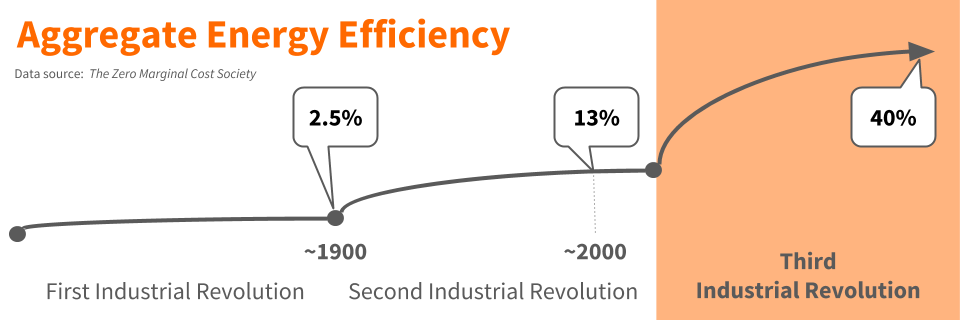
We had this image up on the About page of our website circa 2018!
Mission accomplished
Starting in 2013, we strove to make our work as accessible as reasonably possible: that year saw our first public GitHub commits and our first scientific publication. After all, the foundations of the Internet are all open standards and open source, so why wouldn’t the same be true for the Internet of Things? With our innovative ideas and the code which brings them to life both freely accessible to all, were these to become broadly adopted, we’d have accomplished our mission and effectively eliminated our own jobs, right? And with that society-transforming 3X gain in aggregate energy efficiency, our time would be freed up for new pursuits, right?
Nope. In 2026, we’re busy as ever stewarding open source IoT/RTLS middleware that fosters vendor-agnostic interoperability across the long-established wireless standards. In other words, we’re still working on achieving an IoT that’s actually Internet-like (at least in the sense of the good old days of the Internet)!
Next, let’s speculate on why our prediction didn’t come true.
Exploitation not exploration
Our Creating the next computing industry post from 2017 perhaps best answers why we don’t have an Internet-like Internet of Things today. As Alan Kay succinctly stated:
the goodness of the results is most highly correlated with the goodness of the funding
The Internet and resulting computing industry he and his colleagues and collaborators created were the result of “good” funding that enabled exploration over generous timelines. Contrast that to how we we’ve been financing innovation in recent decades: quarterly, privately, …
It’s not difficult to argue that the pervading business model is to exploit what does not yet exist. We got exactly what we funded for.
Indeed, the IoT to date has largely been a missed opportunity—but that’s the past. Perhaps we can finish on a characteristically optimistic tone!
Funding is (no longer) the problem
While “good” funding would have been beneficial to the emergence of the foundational technologies of the IoT years ago, today they’re largely established and freely accessible to all. The most common IoT applications can now be realised using commodity hardware, existing infrastructure, an open source software stack and common web/data/ops skills on a realistic timeline with a modest budget.
What’s holding the IoT back today isn’t a lack of funding, it’s a lack of general awareness and motivation. And that’s something we can celebrate on IoT Day 2026: the path to ubiquitous IoT is finally clear, if only we can once again get everyone excited about, and working towards it, like during the peak hype back in 2014, when, coincidentally many of the enabling global standards emerged!
Happy IoT Day 2026! Go and put together something useful and show your friends how IoT is cool (again)!
 The reelyActive Blogs