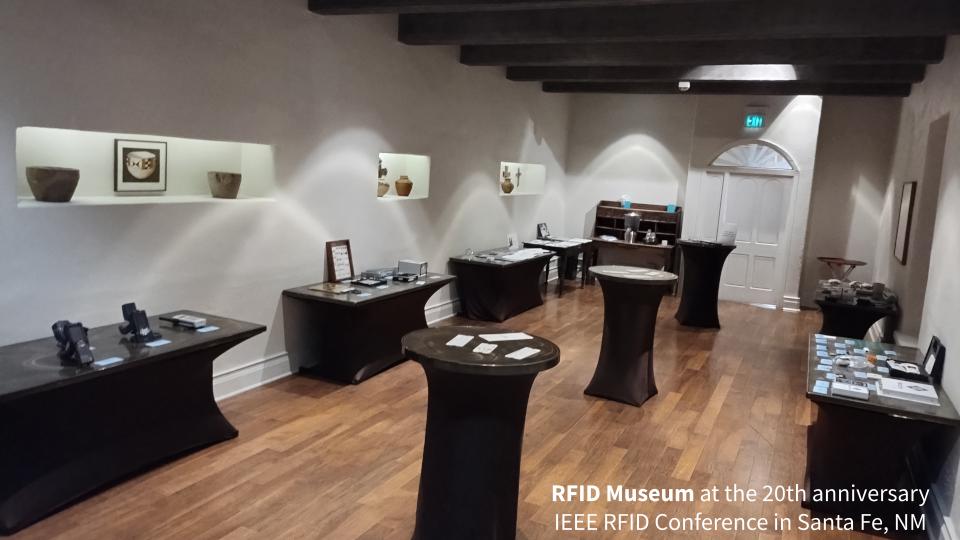
Last week, we attended the 20th anniversary edition of the IEEE RFID conference in Santa Fe, NM. To mark this milestone (pun intended), Mark Roberti, founder and former editor of RFID Journal, a pillar in the industry for a quarter-century, was invited to present the opening keynote. As longtime readers of RFID Journal, we were very much looking forward to his latest industry insights, which we’ll discuss here.
The promise of RFID
In 1999, Kevin Ashton of the MIT Auto-ID Lab coined the term “Internet of Things” (IoT) to describe a future enabled largely by UHF passive RFID tags, which were then beginning commercialisation with the promise to “track and count everything, and greatly reduce waste, loss and cost,” overcoming “the limitations of human-entered data” (see RFID Journal: That Internet of Things Thing).
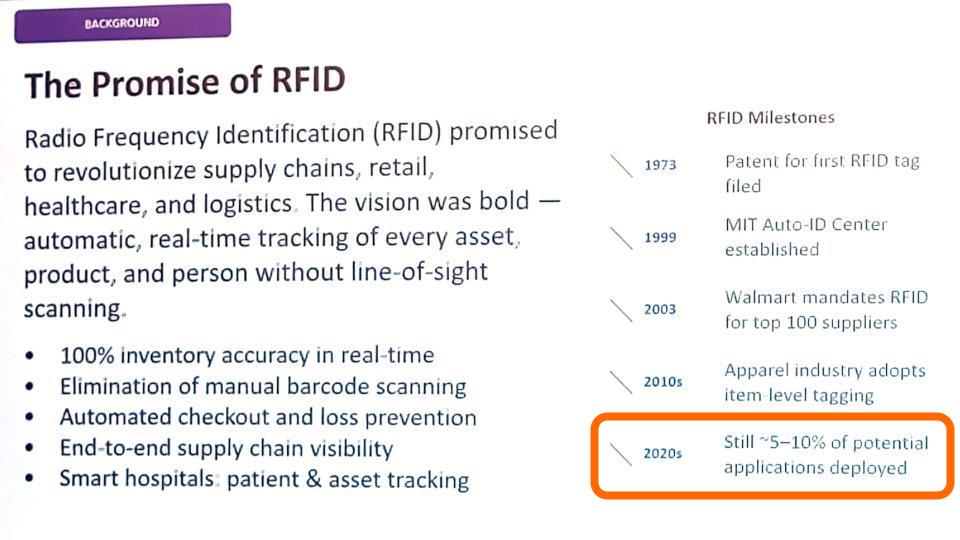
Mark Roberti’s background slide provides an overview of this promise, and importantly, a current adoption metric: Still ~5-10% of potential applications deployed. It doesn’t require a PhD in RFID (which many attendees of the academic conference attendees actually do have!) to recognise that commercial adoption has long fallen short of expectations.
Why RFID hasn’t taken off
Regular readers of RFID Journal won’t be surprised to hear from Mark Roberti that the technology hasn’t met the conditions for crossing the chasm, citing Geoffrey Moore’s book, Crossing the Chasm. We’ll dive deeper into that next.
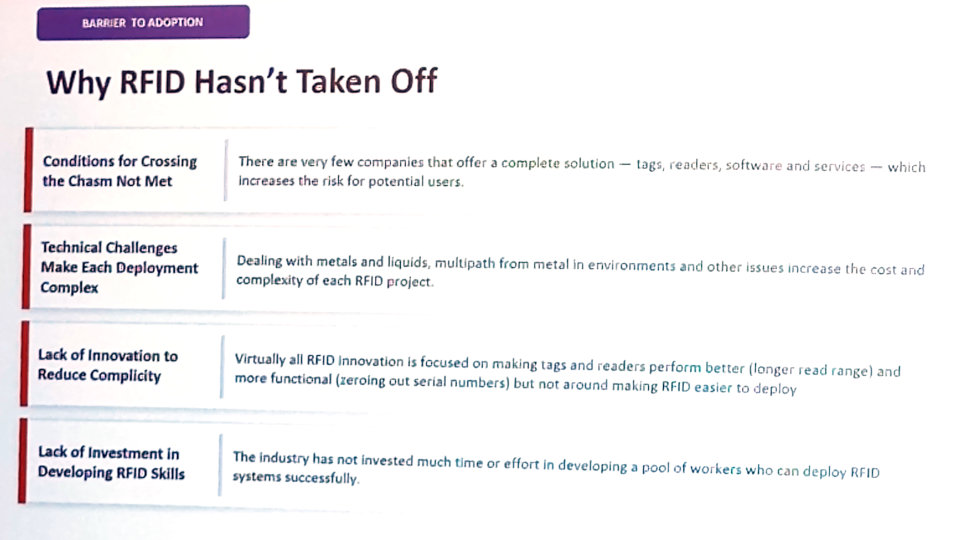
Before we do, let’s underscore how we’re completely in agreement with the three following points:
- Deployments remain too technically complex
- Vendors should innovate to reduce complexity
- Investment in talent development is insufficient
In fact, we founded reelyActive in 2012 with the goal to create simple and accessible active RFID (read Our History) based on our firsthand experience with those barriers to adoption!
Crossing the Chasm
Moore identifies five conditions which a technology, such as RFID, must satisfy to achieve mainstream adoption, which Mark Roberti presented in his Strategic Framework slide.
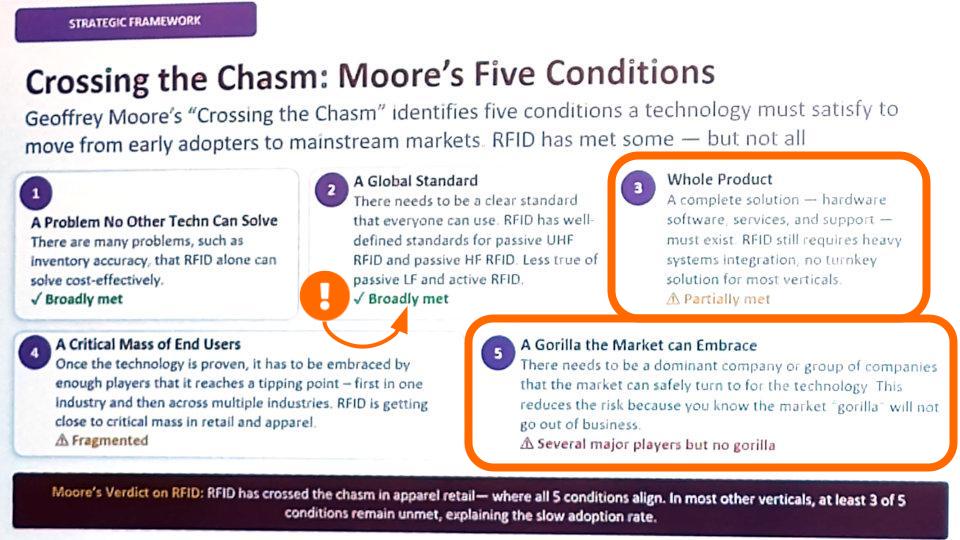
Here we’ll question the interpretation and applicability of several of these conditions with the goal of advancing the conversation around how, as both an industry and an academic research community, we expedite the realisation of the promise of RFID & IoT.
First and foremost, we take issue with the claim that the condition of A Global Standard has been broadly met. Consider the following slide that we presented in our tutorial on Middleware & Applications the previous day.
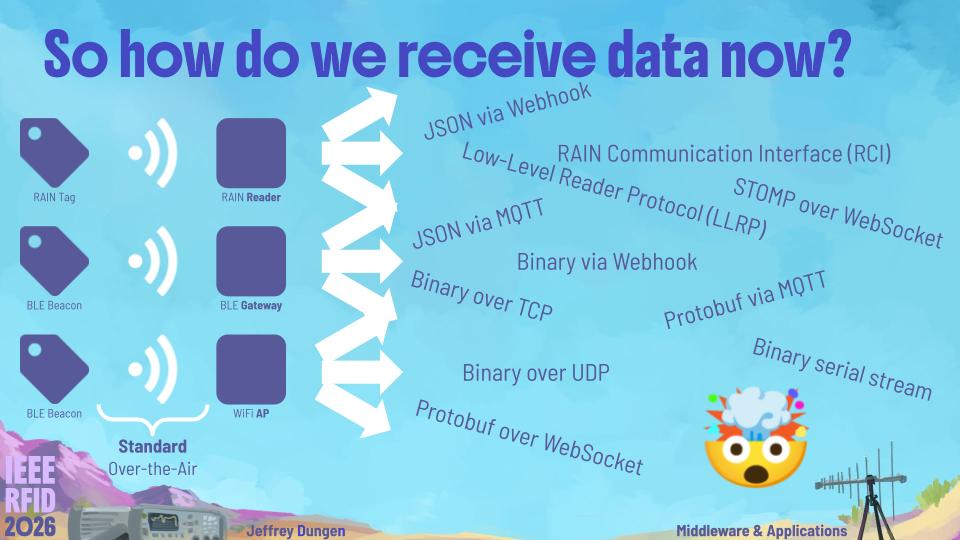
Sure, there are standards over-the-air for RAIN RFID and Bluetooth Low Energy, but then every reader/gateway/AP vendor represents and transports the decoded data their own non-standard way! The resulting mess is yet another barrier to adoption which we’ve been working to solve with our open source middleware that translates the data into a common format, the raddec.
Second, we’re highly skeptical that the Whole Product approach applies for the majority of end users. Sure, end users would love to purchase a complete solution, but in reality, a one-size-fits-most end-to-end product simply isn’t viable for RFID & IoT. At the end of the day, every organisation collects, stores and processes data about their physical operations differently, requiring a unique heterogeneous mix of hardware and software. They are much better served by a vendor ecosystem supporting interoperable, standards-based products and services that can be combined in any way.
Which leads us finally to the Gorilla (that isn’t) in the room. Building on our previous argument, we don’t see a dominant vendor as a necessary condition for mainstream adoption of RFID & IoT.
The current Big Five (Alphabet, Amazon, Apple, Meta & Microsoft) are gorillas, and indeed, Mark Roberti talked about Apple’s iPod as an example of crossing the chasm. But let’s not forget the Apple iBeacon—which is Active RFID—and has failed to cross the chasm by any reasonable interpretation!
In our experience, gorillas struggle to digitise the physical world, which is messy and complex, at whole-product-scale:
- Google’s short-lived Physical Web (BLE) was shut down in 2017 (see also)
- Facebook Bluetooth Beacons were discontinued by 2020 (see also)
- Google, Microsoft, Meta & Apple’s highly anticipated augmented reality (AR) products all failed to achieve adoption at scale
- Google was even a founding member of the RAIN Alliance in 2014 (more on this later…)
And, on a more philosophical note, if computers making sense of the physical world is the future, then we’d be wise to consider who owns the future? Do we really want a gorilla?
The path forward?
What has to happen for RFID adoption to take off? Again, we are in complete agreement that the technology needs to be easier to deploy, and vendors should prioritise innovation to this end. In fact, that would top our list, as we’ve observed that many end users can get along quite well on their own once they gain the confidence to put the pieces of a solution together themselves.
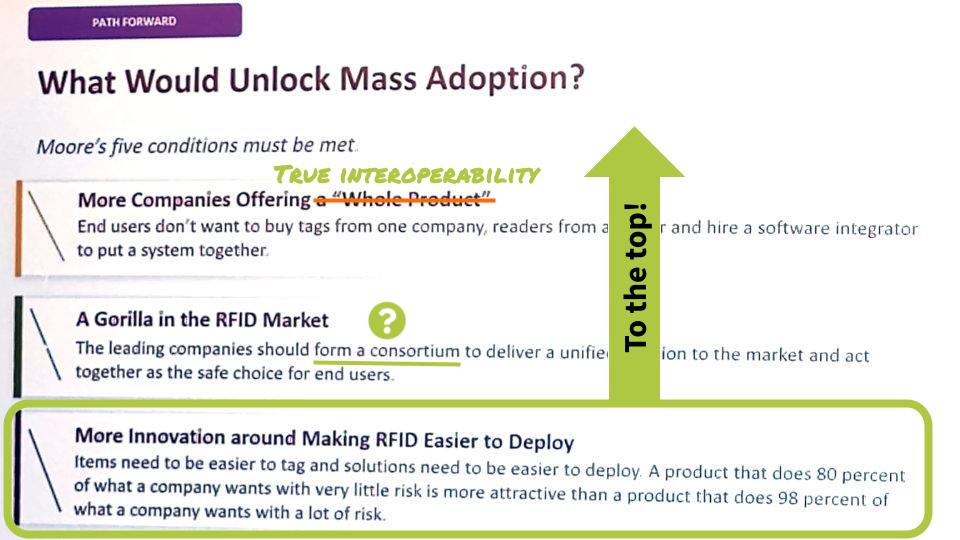
In light of that, rather than striving to create a one-size-fits-few “Whole Product”, we believe that vendors would be better served by making their products and services truly interoperable, making it easier for end users and integrators to put the pieces together. As Mark Roberti suggests,
a product that does 80 percent of what a company wants with very little risk is more attractive than a product that does 98 percent of what a company wants with a lot of risk
Indeed, good enough is better than perfect, and a company can always pursue the remaining 20 percent themselves if the return justifies the risk!
And let’s address the Gorilla (that isn’t) in the room one last time. In 2014, the gorillas Google and Intel, along with Impinj and Smartrac, did form a consortium, as Mark suggests, called the RAIN Alliance. While the alliance’s mission and vision echoes many of his views, and tens of billions of RAIN RFID tags are shipping annually, twelve years in, we’re still a long, long way from the promise of RFID & IoT!
Tap into your inner Gorilla!
What if we revisit the path forward from a different perspective and imagine that the Gorilla has been inside each company all along?
Think of all the success stories we’ve heard at RFID Journal Live over the years: Bloomingdale’s, Airbus, Decathlon, etc. In each case, the company committed to a multi-year endeavour in which they overcame many of the challenges of building an end-to-end solution themselves, developing a precious internal talent pool along the way. With the confidence and autonomy they gained, you might say that each company tapped into, or at least nurtured, their own inner Gorilla!
This is consistent with what we observe with our clients: they are looking inward, rolling up their sleeves, and attempting to put together the pieces of a solution themselves. The products and technologies are “good enough”, their challenge tends to be:
- getting the pieces (hardware & software) to actually work together
- completing an initial end-to-end proof-of-concept
And this is how we at reelyActive have adapted to meet the market: our well-documented open source middleware facilitates getting the pieces to work together, and we offer impartial guidance so that companies can work efficiently towards an initial solution that will be well received as a win, building confidence and developing internal expertise along the way.
We’ve seen this formula work across industries, from power generation to museums to airports to schools. In each case, the only Gorilla was the Gorilla within!
Takeaways
What can we takeaway from all this? In his keynote, Mark Roberti offered six key takeaways which summarise the current state of affairs quite well. We’ve added a note (in orange) to each on his slide below:
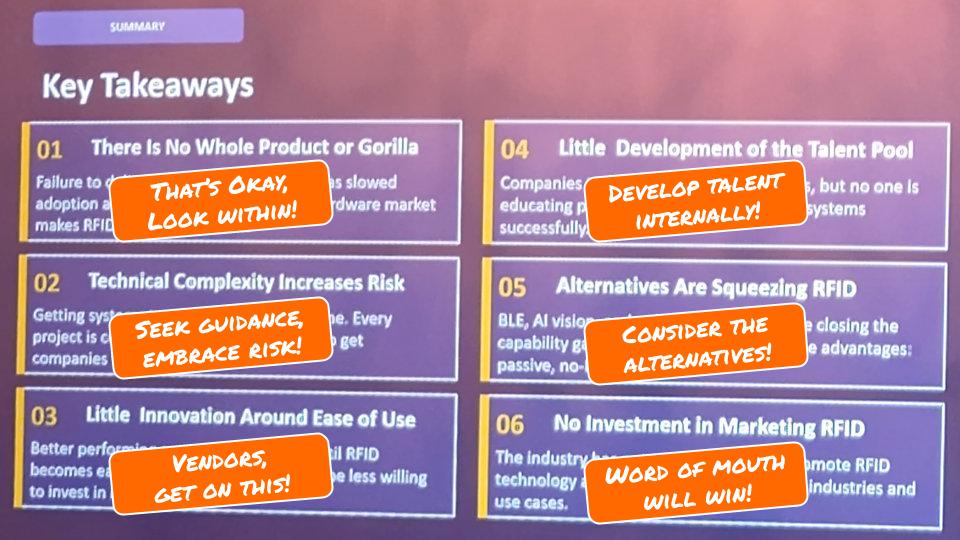
Based on these, for a company looking to adopt RFID & IoT today, we’d offer the following advice:
- don’t expect to buy an end-to-end solution
- seek impartial guidance, be brave, embrace risk
- pressure vendors to make their products truly interoperable
- nurture and develop an internal talent pool—with expert guidance
- combine technologies to suit your own needs (it’s all AIDC!)
- share your experiences and successes with industry peers
It was great to hear Mark Roberti’s perspective at IEEE RFID 2026, and we hope that our comments and feedback contribute positively to the evolution of the industry. We invite you to join us in Memphis in 2027 for what’s shaping up to become a hybrid conference that will bring together both the academic and industrial communities to broaden and further the exchange of ideas!

