reelyActive celebrated its 14th anniversary on July 27th, 2026, and today we kick off our fifteenth fiscal year. If, statistically, most businesses fail within five years, you might say we’re entering super-cockroach startup territory!
Looking back, one of the key reasons we’ve been able to enjoy such longevity has been by maintaining the agility and adaptability of a startup. This allowed us to transition our focus from hardware to SaaS to open source, all while staying true to our founding vision and mission.
Plenty has changed in the past year, and it looks like we have a year of adaptation ahead of us once again. In this post, we’ll take a look at three factors that will test our agility: AI (no surprise), standards (the lack thereof) and hardware (a renewed opportunity).
AI changes where we add value
In the 12+ years we’ve maintained open source code, contributions and issues raised by outsiders have been few and far between, until just recently when we started receiving messages which read something like “my friend Claude suggests that…”. Where users were perhaps once too shy to tell us how to improve our code, nowadays, assisted by mature AI coding tools (like Claude Code), they will now bravely tell us what needs improving, with detailed suggestions on how.
We welcome this change. Feedback is essential, and, honestly, the AI coders have become very good at identifying issues, proposing fixes, writing code and even documenting their work! Leveraging our relatively mature and consistent code base, the AI agents promise to be true force multipliers should we embrace them moving forward.
That could be great for us, but it also means that motivated developers could vibe-code solutions leveraging our existing work, without ever contributing back to the core. While their massively increased output may accelerate Internet of Things (IoT) adoption, without coordination, it would also exacerbate the existing problem of fragmentation. So how, collectively, do we use AI effectively to grow an ecosystem of complementary, interoperable and interchangeable solutions rather than an infinite series of silos?
In a word, standards. And that’s where we expect to add value as coding becomes a commodity.
We’re overdue for standards
At the IEEE RFID 2026 conference in Santa Fe we presented a tutorial on middleware, our current focus, and opened with the following slide, a meme from the film Office Space:
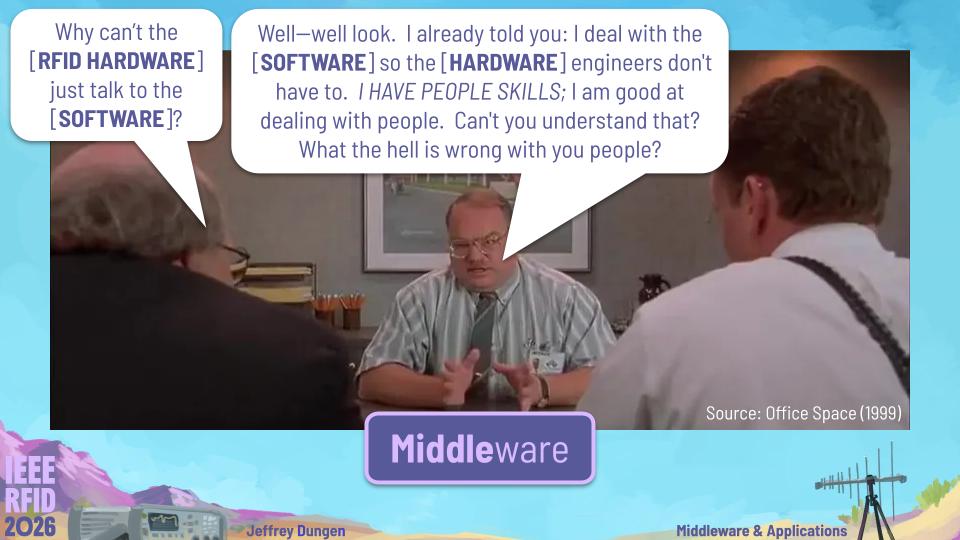
Why can’t the [RFID/IoT hardware] just talk to the [software]?
In short, as we illustrated in a subsequent slide (below), although there are standards for how data is exchanged over-the-air, once wireless tags, sensors and trackers are decoded by gateways, readers and access points, almost without exception, every vendor represents the data in their own format.
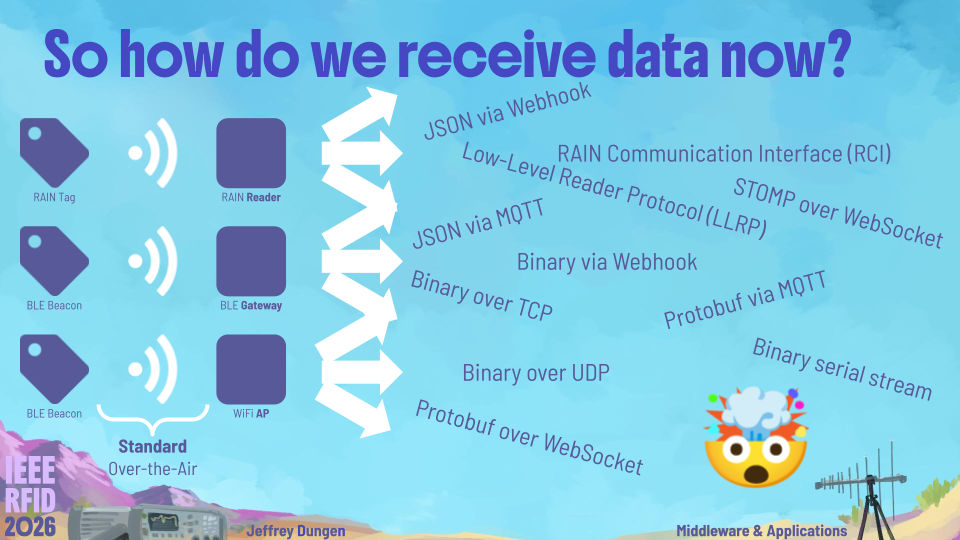
For several years now at reelyActive, we’ve focused on this problem, and have created a viable business making IoT/RFID/RTLS hardware speak a common language, so that integrators and adopters can focus on the application side of things. Were a lingua franca to already exist across vendors and technologies, we would have absolutely no business making middleware. “Things” would be much better in that reality, systems would readily exchange information with one another, solutions would be much easier to stand up, and it would free us up to work on new challenges.
In fact, we’ve been working to make our open source middleware irrelevant since the outset by developing, publishing and adopting open standards that establish a lingua franca across wireless identification, sensing and location technologies. We even created a cheatsheet to facilitate adoption and wrote up tutorials, for instance on best practices for transmitting data observing established standards.
So how do we add value with standards? By encouraging and facilitating their adoption and evolution. It will be another massive challenge for us, but we have strong relationships with many of the leading gateway/reader/AP vendors as well as independent organisations such as the IEEE. And, of course, we can always go back to building hardware that observes the standards we’re promoting, right?
Another hardware renaissance?
At the time of our founding In 2012, we were developing novel reelceiver gateways based on the venerable 8051 microcontroller, painstakingly programmed in a mix of C and assembly. Today, you can purchase, off-the-shelf for under $10, a multi-radio microcontroller programmable in high-level languages like JavaScript and MicroPython.
In recent discussions with technology partners and clients, it has become apparent that there is a largely unaddressed need for easy-to-deploy commodity gateways to extend wireless coverage and facilitate real-time location. Essentially, our 15-year-old founding innovation appears to be back in vogue.
In our lab right now are plenty of the aforementioned multi-radio microcontrollers which we’ve validated as candidate gateways running our open source code adapted to MicroPython. And yes, they observe the open standards we’ve established to ensure easy interfacing with all the familiar platforms with which we’ve already integrated our middleware. Why not lead by example? Clearly it has worked out well enough for us before!
What we reckon comes next…
As should now be obvious from this post, one thing is certain: reelyActive is about to reinvent itself once again. AI can finally free us up from the chore of coding to focus again on our core mission of establishing a common language for computers to make sense of, and exchange information about, the physical world. And we can reinvigorate our hardware roots to lead the adoption of open standards by example. Will we succeed in this transition? Let’s see where we land on our 15-year anniversary in 2027!

