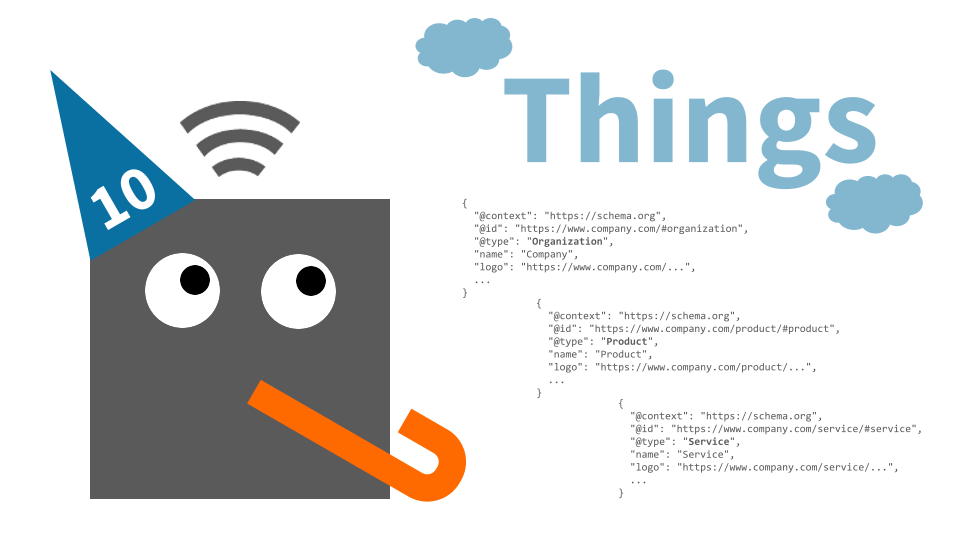
Yes, as in “we’re still having to look up things” after ten years. Specifically radio-identifiable things, for which there’s still no observed, standard way to look them up.
Today, August 29th, 2026, Sniffypedia is celebrating its ten year anniversary, and we invite you to read about the project’s history and future, 10 years on. In short, Sniffypedia was supposed to be a stopgap to facilitate looking up the name and image of products, services and organisations that could be wirelessly identified, while an industry-standard lookup method emerged.
A standard for looking up structured data about products, services and organisations on the Web did indeed emerge—but—it is not consistently observed, and modern security practices impede open access even when it is observed. So, Sniffypedia is more than a stopgap. It remains relevant today.
In modern technology terms, a decade is an eternity. Clearly something is wrong if a project designed to become irrelevant can’t achieve its stated goal, 10 years on. And that’s what this blog post will touch on, briefly.
Clearly something is wrong if a project designed to become irrelevant can’t achieve its stated goal, 10 years on.
Remember the Internet? You’re almost certainly reading this blog post thanks to the Internet. The success of the Internet can largely be attributed to the fact that it was first developed to maturity for non-commercial purposes before providing a standard platform for countless commercial applications. In other words:
- make it work
- make it make money
How about the Internet of Things? If you read our blog posts, you probably have a good notion of the IoT. But the average person has never heard of the Internet of Things, despite their familiarity with the Internet. And that makes sense, because, if we’re being honest, even today, we don’t really have an Internet of Things like we have an Internet. Why is that?
Unlike the Internet, the IoT was never developed to maturity for non-commercial purposes before being exploited to commercial ends. In simple terms, the IoT wasn’t made to work before it was made to make money. And that largely explains where we are today: some siloed successes, but no commercial boom like we saw for the Internet. The foundation was never there. Clearly we’re not creating the next computing industry (that blog post is almost a decade old too!). There never was “good” funding for the IoT like there was for the Internet.
In 2012, when we founded reelyActive, we envisaged an IoT-enabled future far, far more advanced than what we’ve ended up with today. As we foresaw, all of the technological ingredients emerged: global wireless standards like Bluetooth Low Energy and RAIN RFID, ubiquitous infrastructure like IoT-radio-enabled wireless access points (APs), open source technology stacks, and even accessible AI. But we were among the rare few working to “make it work” first, so that we could all benefit from making it make money. And the IoT would have made a TON more money by now, had, collectively, we made it work first.

So, coming back to the initial question, are things looking up after ten years? Yes and no. Yes, because many of the foundational elements of the IoT have emerged, and they just need to be put together in a consistent way to enable an Internet-like Internet of Things. No, because the “make it make money” mentality is stronger than ever, as the crypto and AI booms that succeeded that of the IoT have demonstrated without a doubt.
But let’s create a cause for optimism: the AI models that are being used today to vibe code IoT applications were all trained on the trove of open source code and documentation that we, and other like-minded organisations and individuals, published over the past decade. Perhaps all our efforts to “make it work” will have paid off by being extensively and consistently adopted in AI-generated code. Then things would truly be looking up, and Sniffypedia would achieve its stated goal of becoming nothing more than an index!

